Fractions
Multiplying fractions
Dividing fractions
Dividing by a fraction is the same as multiplying by the reciprocal.
Removing common factors
Distributive law with fractions
Adding mixed-denominator fractions
When the denominators have a common factor, first separate these out to the side and then multiply by the uncommon factors. This saves time and effort with complex equations. In the following example, x and 3 are the uncommon factors.
Exponents
Basic forms
Fractional exponents
Negative exponents
Multiplying exponents
Dividing exponents
Exponents of exponents
Distributive law with exponents
Exponentation distributes over multiplication.
Notation for roots
- The expression \sqrt{x} or x^{\frac{1}{2}} represents the positive square root.
- The expression -\sqrt{x} or -(x^{\frac{1}{2}}) represents the negative square root.
- The expression \pm\sqrt{x} or \pm(x^{\frac{1}{2}}) represents both square roots.
- When asked to ‘solve for x when x^2 = 4, both roots are required.
Multiplying conjugate roots
The conjugate of \sqrt{x} + \sqrt{y} is \sqrt{x} - \sqrt{y}, and vice versa.
Rationalising the denominator
For any fraction with a square root in the denominator, we can lift the square root up to the numerator by multiplying both the numerator and the denominator by the conjugate of the denominator.
Equations and inequalities
To preserve an equality, any operation performed on one side of the equality must also be performed on the other side.
Notation for intervals
- x \in (a, b) denotes an open interval (where a < x < b)
- x \in [a, b] denotes a closed interval (where a <= x <= b)
- Intervals can also be half-open (as x \in (a, b] or vice versa)
Multiplying or dividing by a negative value
When multiplying or dividing an inequality by a negative number, we must reverse the direction of the inequality (the signs of both values flip and they end up on opposite sides of zero).
We can’t multiply or divide an inequality by an unknown term, because the sign of that term isn’t yet known. To deal with this, we use addition and subtraction to rewrite the inequality to have zero on one side, we merge all terms into one term, and then we solve to find the values of the unknown terms.
Critical points for inequalities
A critical point for an equation is an input value that makes the result zero or undefined. These points are the only points along the number line where the sign of the result changes, the intervals between critical points will be all positive or all negative.
The critical values of the inequality \frac{-2x - 1}{x - 2} < 0 are x = -\frac{1}{2} (zero) and x = 2 (undefined), because of how fractions work. We have to make the other side be zero first for this trick to work. We now have three intervals, x < -\frac{1}{2}, -\frac{1}{2} < x < 2, and 2 < x.
Finally, we probe a value within each interval to find the sign of that interval (say, test the values -3, 0, and 3), and find that the intervals are negative, positive, and negative, respectively. We can use this to say that the equation is true where x \le -\frac{1}{2} or x > 2. This can be expressed with interval notation as \left( -\infty, -\frac{1}{2} \right] \union \left( 2, \infty \right), which is inelegant, but the set builder notation was worse.
Quadratic equations
It is much easier to work with and to solve quadratic equations that are in a factored form. The factored form of a quadratic equation is the product of two linear forms:
Factoring quadratic equations by guessing
One way to factor is to find the product of the coefficients of x^2 and x^0, and then find two numbers that will multiply to give that product and will also sum to give the coefficient of x^1. For
the product is -12 and the pair of factors that sums to 1 is -3 and 4. We construct our linear forms, using the x^2 coefficient in both along with each found factor, dividing the whole thing by the x^2 coefficient:
It should be straightforward to factor out of one of the linear forms a value equal to the denominator, cancelling to yield (x - 1)(3x + 4).
Factoring quadratic equations with a visual aid
There’s also a visual aid with boxes that can help with this approach:
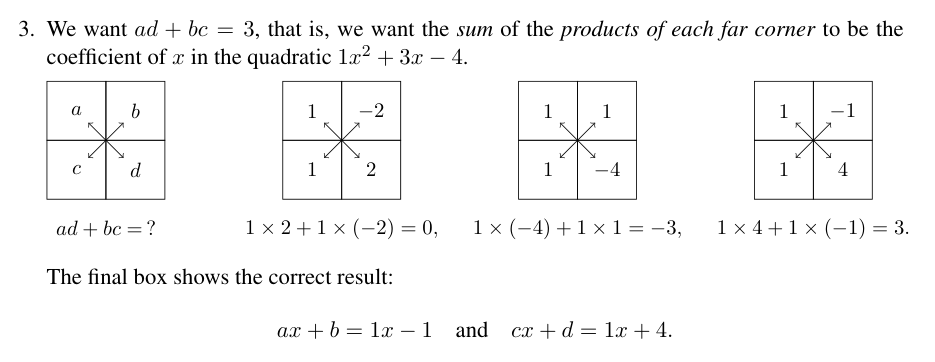
When we solve a quadratic equation, we are finding the values for each variable that will make the equation true. Every quadratic equation will have zero, one, or two real solutions.
We can use the fact that if ab = 0 then a = 0 or b = 0 (or both). Given a factored quadratic equation in the form (ax + b)(cx + d) = 0, we know that either ax + b = 0 or cx + d = 0.
In the example equation x^2 + 3x - 4 = (x+1)(x-4) from above, x = -1 or x = 4.
Solving quadratic equations by completing the square
If the result is the difference of two squares (so \frac{b^2}{4} - c \geq 0) then we can solve the equation. If, however, the result is the sum of two squares (so \frac{b^2}{4} - c < 0) then the equation has no real solutions.
Once the equation is in the form (x + \frac{b}{2})^2 - \frac{b^2}{4} + c = 0, we can see that (x + \frac{b}{2})^2 = \frac{b^2}{4} - c. To find the solutions of x, we take the square root of both sides and solve for x:
Solving quadratic equations using the quadratic formula
The coefficients of the polynomial can be substituted into the equation and then solved to directly find the values of x.
The discriminant is the portion b^2 - 4ac beneath the square root, and can be used to determine the number of real solutions. If the discriminant is negative, there are no real solutions to the equation. If it’s zero, there’s one, and if it’s positive, there are two.
Logarithms
If f(x) = 2^x, then f^{-1}(x) = \log_2 x. This is the function reflected by the line y = x.
\log_n x is not defined for x \le 0. It intercepts the x-axis at x = 1.
Composing exponentation function with logarithm function
If f(x) = a^x, then f^{-1}(x) = \log_a x. Since f(x) \circ f'(x) = f(f'(x)) = x:
Addition and subtraction of logarithms
Beware of the following common error:
Multiples of logarithms
Taking both sides of an equation
Exponential function
Has a y-intercept of 1, and is always positive, with a positive slope. As x \to -\infty, e^x \to 0, and as x \to \infty, e^x \to \infty
e^{-x} is a reflection of e^x in the y-axis.
Natural logarithm function
Undefined at x = 0.
Summation
A list of numbers given by a function on the set of integers \bb{Z} is called a sequence.
The sum of a sequence is called a series.
Factoring a sum
We can factor out a constant multiple from all the summands. That is, multiplication is distributive over addition.
Summation of sums
The sum of two summations is the summation of the sums. That is, addition is associative.
Consecutive sums
Consecutive sums can be combined.
Summation of constants
Useful formulae
The formula for the summation of consecutive natural numbers:
The formula for the summation of consecutive squares:
Arithmetic sequence
An arithmetic sequence starts at a constant a, with each term being equal to the previous term plus a constant d.
The sum of an arithmetic sequence is:
Geometric sequence
A geometric sequence starts at a constant a, with each term being equal to the previous term multiplied by a constant r.
The sum of a geometric sequence is:
If |r| < 1, then the sum of an infinite geometric sequence is a finite number, and is: